Architecture
Platform Overview
Rose is an AI-first inbound marketing platform built as a distributed system. The production Website Agent combines a browser widget, Cloudflare edge routing, FastAPI services on Cloud Run, LangGraph orchestration, retrieval infrastructure, and external model and enrichment providers.
Agent Architecture
Rose agents follow a common four-layer pattern:
| Layer | Purpose | Website Agent example |
|---|---|---|
| Frontend interface | User-facing surface | React widget |
| API service | Authentication, validation, and transport | Search API |
| Agent core | Business logic and orchestration | ixchat LangGraph |
| Shared infrastructure | Retrieval, models, storage, and configuration | ixrag, ixllm, Redis, MongoDB, Neo4j |
Active Agents
| Agent | Frontend | Backend API | Core package |
|---|---|---|---|
| Website Agent | frontend/widget/ |
backend/apps/api/search/ |
ixchat |
See Agents Overview for beta and roadmap agents.
Supporting Services
| Service | Responsibility |
|---|---|
| Admin API | Authenticated backoffice BFF for privileged operations |
| Knowledge API | Durable knowledge workflow owner, dispatcher, recovery endpoint, and status API |
| Knowledge content worker | Executes discovery, scrape, and clean stages and writes immutable GCS artifacts |
| Integrations API | HubSpot OAuth, webhooks, and integration task handling |
| IXVector API | Identity and enrichment webhook ingestion |
| Rose MCP | Hosted MCP interface for external agent clients |
System Components
- Product surfaces: Astro marketing website, React widget, client backoffice, playground, and Chrome extension.
- Cloudflare edge: Astro website Worker, the
api.userose.aiunified proxy, Cloudflare Pages, GCS widget assets, and R2 GEO pages. - Cloud Run services: Search, Admin, Knowledge, knowledge content worker, Integrations, IXVector, and Rose MCP.
- Async execution: Cloud Tasks queues, Cloud Scheduler recovery, document loading, tagging, website mapping, PostHog batch processing, HubSpot sync, the fenced FAQ rollback job, and GEO publishing.
- Data: Supabase Postgres, Redis, MongoDB, Neo4j, the
rose-scrapingGCS bucket, the widget CDN bucket, and Cloudflare R2. - Providers: model and embedding vendors, visitor enrichment providers, observability and analytics products, and CRM/tools.
Architecture Diagram
The diagram reads top-to-bottom through seven layers: users, product surfaces, Cloudflare edge, Cloud Run services, asynchronous orchestration, data, and external providers. Detailed arrows are limited to the real-time chat lane and the knowledge-ingestion control plane so the operational paths remain legible.
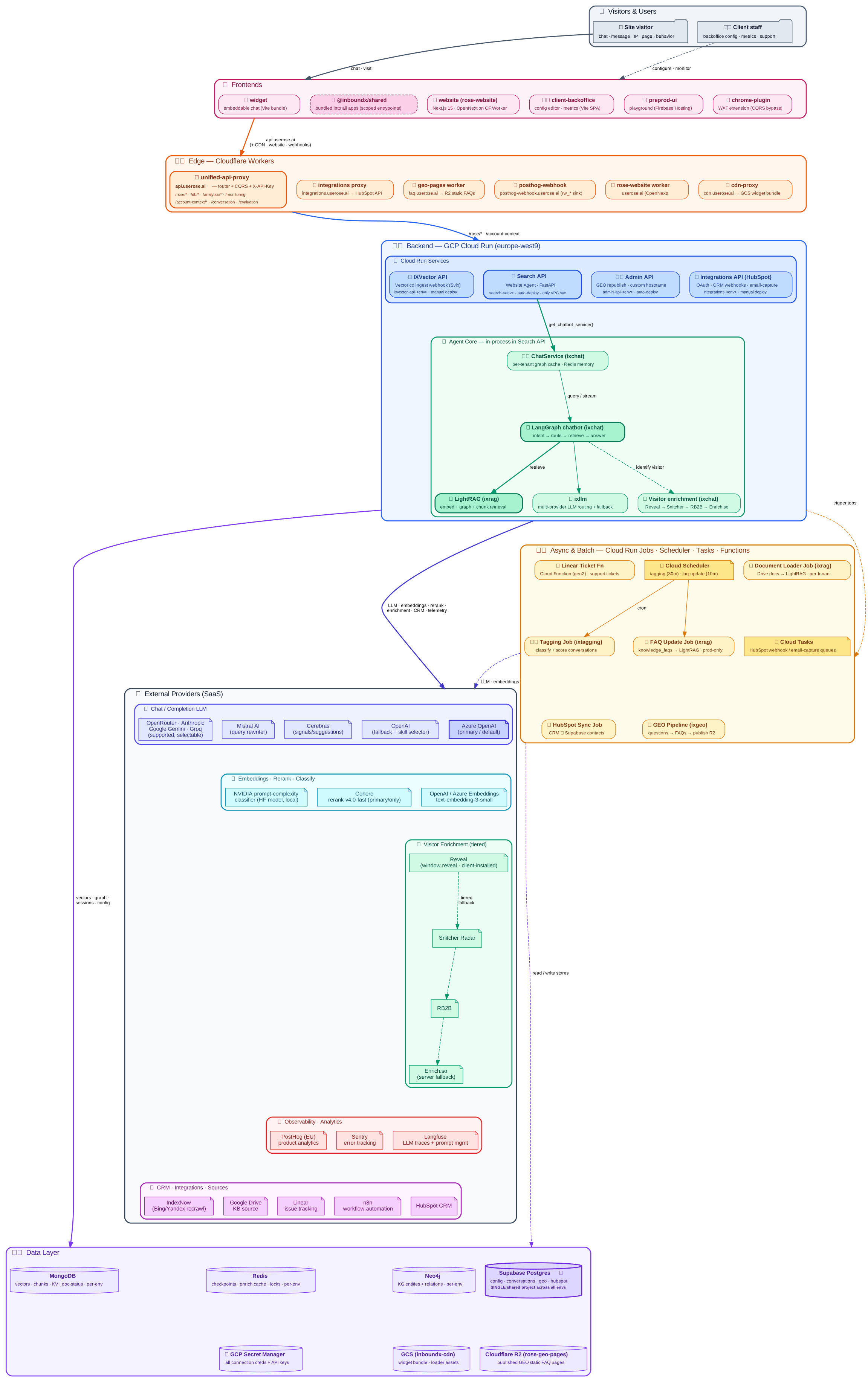
Source of truth:
docs/diagrams/rose-system-architecture.dot.just devandjust buildrender the SVG intosrc/_generated/; do not edit or commit that generated asset. See the diagram inventory for ownership rules.
Component Details
Product Surfaces
| Component | Purpose | Technology |
|---|---|---|
| Marketing website | userose.ai |
Astro 6 with @astrojs/cloudflare |
| Widget | Embeddable Website Agent | React, TypeScript, UMD bundle |
| Client backoffice | Analytics, configuration, content, and operations | React, Vite, Cloudflare Pages |
| Playground | Internal testing across clients and environments | React, Vite, Firebase Hosting |
| Chrome extension | Inject and test Rose on arbitrary sites | WXT / Chrome Extension APIs |
The standalone stats opt-out extension is a developer tool and is intentionally not shown in the hosted runtime diagram. See Frontend Overview.
Backend Packages
| Package | Responsibility |
|---|---|
| ixchat | Website Agent LangGraph, skills, memory, and response routing |
| ixrag | LightRAG retrieval and tenant-aware storage integration |
| ixllm | Multi-provider model routing and fallback |
| ixknowledge | Knowledge workflow contracts and domain logic |
| ixscraping | Website discovery, scraping, and cleaning logic |
| ixconfig | Typed unified configuration models and resolver |
| ixskills | Global and per-client agent skill system |
| ixmongo / ixneo4j | Tenant-aware MongoDB and Neo4j adapters |
| ixdata / ixinfra / ixweb | Data access, shared runtime utilities, and web boundaries |
| ixgeo | GEO content generation and publishing |
| ixtagging / ixevaluation | Conversation classification and evaluation tooling |
Async and Batch Execution
| Execution unit | Trigger | Responsibility |
|---|---|---|
| Knowledge content worker | Discovery, scrape, and clean Cloud Tasks queues | Produce immutable artifacts and report fenced results to Knowledge API |
| Document loader | Knowledge API / approved on-demand execution | Write controlled snapshots to LightRAG, MongoDB, and Neo4j |
| Tagging | Cloud Scheduler | Classify and score conversations |
| Website mapping | Scheduled Cloud Run Job | Refresh website mapping data |
| PostHog batch processor | Scheduled Cloud Run Job, production only | Convert raw batch exports into analytics tables |
| HubSpot contacts sync | Jobs API / on demand | Synchronize CRM contacts and Rose data |
| FAQ update | Scheduled, production-only rollback path | Legacy direct knowledge_faqs ingestion; fenced during controlled cutover |
| GEO pipeline | On demand | Generate geo.faqs publishing content and deploy static R2 pages |
config.knowledge_faqs is chat retrieval knowledge. geo.faqs is generated
publishing content and never enters the chat ingestion path.
Data Layer
- Supabase Postgres: configuration, conversations, analytics, GEO content, knowledge workflow state, immutable snapshot metadata, and freshness state.
- Redis: LangGraph checkpoints, conversation memory, locks, and caches.
- MongoDB: LightRAG chunks, vectors, key-value state, and document status.
- Neo4j: tenant-aware knowledge graph nodes and relationships.
- GCS
rose-scraping: immutable source and processing artifacts for the knowledge control plane. - GCS
inboundx-cdnand Cloudflare R2: widget assets and published GEO pages.
External Providers
Model selection is role-based rather than one global default:
| Role | Providers |
|---|---|
| Answer generation and fallbacks | Azure OpenAI and OpenAI |
| Fast routing, signals, and suggestions | Cerebras with configured fallbacks |
| Query rewriting | Mistral |
| Scraping decisions and selectable routes | OpenRouter routes, including Anthropic, Gemini, and Groq |
| Embeddings | Azure/OpenAI embeddings |
| Identity and enrichment | Reveal, Snitcher, RB2B, Vector, and Enrich.so |
| Observability and analytics | Langfuse, Sentry, and PostHog EU |
| CRM and tools | HubSpot, n8n, Linear, Google Drive, and IndexNow |
The authoritative per-task model routing lives in
backend/packages/ixchat/ixchat/chat_routing.py; the diagram deliberately
avoids model-version labels that change frequently.
Primary Data Flows
Chat Request
- The widget sends a chat request through
api.userose.ai. - The Search API validates the request and invokes
ixchat. - LangGraph starts retrieval, enrichment, and profiling work and routes the turn through the appropriate response path.
ixragreads MongoDB and Neo4j;ixllmselects the configured model route.- Tokens stream back through the API proxy while checkpoints remain in Redis and conversation/profile data is persisted in Supabase.
The complete graph is generated from code on the IXChat package page.
Knowledge Ingestion
- Backoffice producers call the Admin API, which authorizes the user and calls the private Knowledge API with service-to-service OIDC.
- The Knowledge API records durable operation state in Supabase before dispatching discovery, scrape, or clean work to Cloud Tasks.
- The content worker writes immutable artifacts to GCS and reports fenced results to the Knowledge API.
- After snapshots converge, the Knowledge API admits the document-loader job, the only controlled writer to LightRAG stores.
- Cloud Scheduler invokes the same API dispatcher to recover pending or ambiguous work.
See Knowledge ingestion control plane for state transitions and operational details.
Analytics
- The widget sends events to PostHog through the unified analytics proxy.
- For
$pageviewand$pageleave, shadow mode also sends PostHog's canonical event to a narrow unified-Worker endpoint. The Worker durably enqueues it, and a private Queue consumer batches it intoanalytics.first_party_page_events_rawusing a service-role-only RPC. - PostHog exports batches into
posthog_events_rawin Supabase. - The production-only PostHog batch processor updates visitor sessions, page views, session events, conversations, and analytics marts.
- Backoffice pages read those tables and RPCs directly through RLS-protected Supabase access.
The shadow path keeps PostHog unchanged while its event UUIDs are compared with
the first-party copy. Operational deployment steps live in
backend/cloudflare/README_clean.md; the phased cutover design is recorded in
the PostHog cost and removal ADR.